.
There are no coordinates
.
There are no coordinates
 and
and
 associated with internal angular momentum so the
only thing we have is our spinor representation.
associated with internal angular momentum so the
only thing we have is our spinor representation.
The usual basis states are the eigenstates of
 .
We know the eigenvalues are
.
We know the eigenvalues are
 and
and
 .
It is easy to
derive
the matrix operators for spin.
.
It is easy to
derive
the matrix operators for spin.

The Pauli Spin Matrices,
 , are simply defined and have the following properties.
![\begin{eqnarray*}
& S_i \equiv {\hbar\over 2} \sigma_i. \\
& \vec{S}={\hbar\ove...
... [\sigma_i,\sigma_j]=2i\epsilon_{ijk}\sigma_k \\
& \sigma_i^2=1
\end{eqnarray*}](img88.gif)

 matrices are the Hermitian, Traceless matrices of dimension 2.
Any 2 by 2 matrix can be written as a linear combination of the
matrices and the identity.
matrices are the Hermitian, Traceless matrices of dimension 2.
Any 2 by 2 matrix can be written as a linear combination of the
matrices and the identity.
Example:
The expectation value of  .
.
Example:
The eigenvectors of .
Example:
The eigenvectors of  .
.
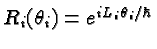
The rotation operators, for rotations of the coordinate axes can be
computed
from the formula
 .
.

 radians is minus the identity matrix
for any of the axes (because
radians is minus the identity matrix
for any of the axes (because
 appears everywhere).
The surprising result is that the sign of the wave function of all fermions is changed
if we rotate through 360 degrees.
appears everywhere).
The surprising result is that the sign of the wave function of all fermions is changed
if we rotate through 360 degrees.
As for orbital angular momentum (
 ), there is also a magnetic moment associated with
internal angular momentum (
), there is also a magnetic moment associated with
internal angular momentum (
 ).
).
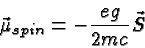
 , the gyromagnetic ratio, compared to
the formula for orbital angular momenta.
For pointlike particles, like the electron,
has been computed in Quantum ElectroDynamics
to be a bit over 2,
, the gyromagnetic ratio, compared to
the formula for orbital angular momenta.
For pointlike particles, like the electron,
has been computed in Quantum ElectroDynamics
to be a bit over 2,
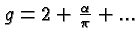 .
For particles with structure, like the proton or neutron,
is hard to compute, but has
been measured.
Because the factor of 2 from
cancels the factor of 2 from
.
For particles with structure, like the proton or neutron,
is hard to compute, but has
been measured.
Because the factor of 2 from
cancels the factor of 2 from
 ,
the magnetic moment due to the spin of an electron is almost exactly equal to the magnetic
moment due to the orbital angular momentum in an
,
the magnetic moment due to the spin of an electron is almost exactly equal to the magnetic
moment due to the orbital angular momentum in an
 state.
Both are 1 Bohr Magneton,
state.
Both are 1 Bohr Magneton,
 .
.

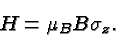
 axis to be in the direction of
 , then this reduces to