


 State in a B field
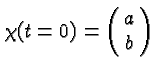 and we
have chosen the z axis to be in the field direction.
The upper component of the vector (a) is the amplitude to have spin up along the z direction,
and the lower component (b) is the amplitude to have spin down.
Because of our choice of axes, the spin up and spin down states are also the energy eigenstates
with energy eigenvalues of
and we
have chosen the z axis to be in the field direction.
The upper component of the vector (a) is the amplitude to have spin up along the z direction,
and the lower component (b) is the amplitude to have spin down.
Because of our choice of axes, the spin up and spin down states are also the energy eigenstates
with energy eigenvalues of
 and
and
 respectively.
We know that the energy eigenstates evolve with time quite simply (recall the separation of the
Schroedinger equation where
respectively.
We know that the energy eigenstates evolve with time quite simply (recall the separation of the
Schroedinger equation where
 ).
So its simple to write down the time evolved state vector.
).
So its simple to write down the time evolved state vector.

 .
.
So let's say we start out in the state with spin up along the x axis,
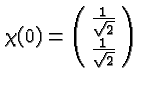 .
We then have
.
We then have
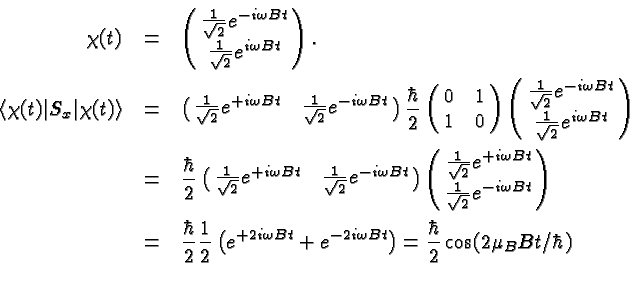
So again the spin precesses around the magnetic field. Because
 the rate is twice as
high as for
the rate is twice as
high as for
 .
.
The remainder of this section is another, more complete, explanation of the time development.
It is somewhat notationally challenged.
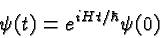
Recall that, for any arbitrary system in Quantum Mechanics, a state vector
 describing the system at some particular time
 will evolve under
the action of the ``Time Evolution Operator'':
will evolve under
the action of the ``Time Evolution Operator'':
 system...'').
For this system
system...'').
For this system
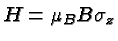 ,
so that the time evolution operator becomes
,
so that the time evolution operator becomes
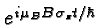 and, using spinor notation, we write

![\begin{displaymath}\bgroup\color{black}\left(\matrix{\chi_1(t) \cr \chi_2(t)}\ri...
...right]}
\left(\matrix{\chi_1(0) \cr \chi_2(0)}\right ) \egroup\end{displaymath}](img213.gif)
 .
.
?? . . . Mathematical Note on exponentiation of matrices . . . ??
As usual, we know how the operator
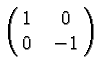 in the
exponent acts on its eigenstates (basis vectors), so we decompose the arbitrary
state vector into a linear combination of eigenstates:
in the
exponent acts on its eigenstates (basis vectors), so we decompose the arbitrary
state vector into a linear combination of eigenstates:


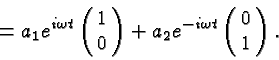
Let's look at the expectation values of the three spin operators on an such an
arbitrary state:
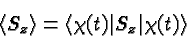

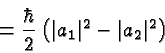
so it appears that the expectation
 will
remain stationary in time for any arbitrary state. Meanwhile, substituting
will
remain stationary in time for any arbitrary state. Meanwhile, substituting
 and
and
 in the above derivation yields
![\begin{displaymath}\bgroup\color{black}\langle S_x \rangle = {\hbar\over 2} \lef...
...1a^*_2 e^{2i\omega t} +
a^*_1a_2 e^{-2i\omega t}\right] \egroup\end{displaymath}](img224.gif)
![\begin{displaymath}\bgroup\color{black} \langle S_y \rangle
= {i\hbar\over 2} \...
...1a^*_2 e^{2i\omega t} - a^*_1a_2 e^{-2i\omega
t}\right] \egroup\end{displaymath}](img225.gif)
To see that this is a rotation, absorb
 into the exponent i.e.,
express
into the exponent i.e.,
express
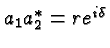 where r and
 are real constants. Then

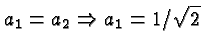 for normalization so that
 ). Thus,


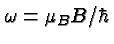
Hence the state precesses about the z-axis with angular frequency
 .
Compare this to the
case: here the state rotates twice as fast!
.
Compare this to the
case: here the state rotates twice as fast!