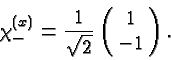
for Spin
 must be
 .
So, factoring out the constant, we have
.
So, factoring out the constant, we have
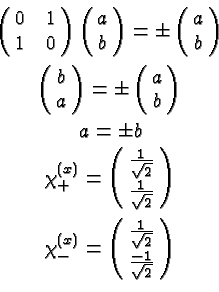 . We see that if we are in an
eigenstate of
the spin measured in the z direction is equally
likely to be up and down since the absolute square of either amplitude is
.
. We see that if we are in an
eigenstate of
the spin measured in the z direction is equally
likely to be up and down since the absolute square of either amplitude is
.
The remainder of this section goes into more detail on this calculation but is currently notationally challenged.
Recall the standard method of finding eigenvectors and eigenvalues:

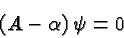
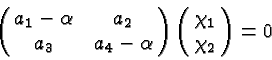
 system we have, in matrix notation,


For a matrix times a nonzero vector to give zero, the determinant of the
matrix must be zero.
This gives the ``characteristic
equation'' which for spin
systems will be a quadratic equation in
the eigenvalue
 :
:



To find the eigenvectors, we simply replace (one at a time) each of the
eigenvalues above into the equation
 and
and
 .
.
Now specifically, for the operator
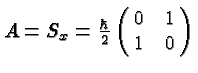 , the eigenvalue equation
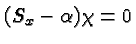 becomes, in
matrix notation,
becomes, in
matrix notation,

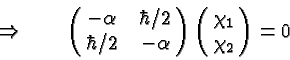
The characteristic equation is
 , or
, or

 back into the eigenvalue equation, we obtain

 (just write out the
two component equations to see this). Hence the normalized eigenvector
corresponding to the eigenvalue
(just write out the
two component equations to see this). Hence the normalized eigenvector
corresponding to the eigenvalue
 is
is
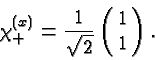
Similarly, we find for the eigenvalue
 ,
,