next up previous
Next: Derive Spin Rotation Matrices Up: Derivations and Computations Previous: Compute the Rotation Operator


Derive Spin \bgroup\color{black}${1\over 2}$\egroup Operators

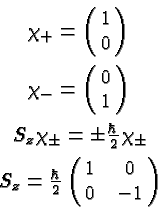
We will again use eigenstates of \bgroup\color{black}$S_z$\egroup, as the basis states.

\begin{eqnarray*}
& \chi_+=\pmatrix{1 \cr 0} \\
& \chi_-=\pmatrix{0 \cr 1} \\
...
...ar\over 2}\chi_\pm \\
& S_z={\hbar\over 2}\pmatrix{1&0\cr 0&-1}
\end{eqnarray*}


Its easy to see that this is the only matrix that works. It must be diagonal since the basis states are eigenvectors of the matrix. The correct eigenvalues appear on the diagonal.

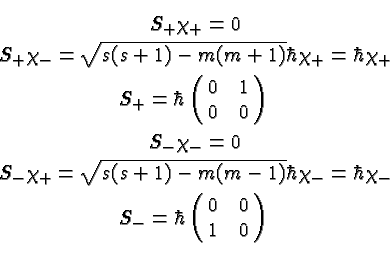
Now we do the raising and lowering operators.

\begin{eqnarray*}
& S_+\chi_+=0 \\
& S_+\chi_-=\sqrt{s(s+1)-m(m+1)}\hbar\chi_+=...
...r\chi_-=\hbar\chi_- \\
& S_-=\hbar\pmatrix{0 & 0 \cr 1 & 0} \\
\end{eqnarray*}


We can now calculate \bgroup\color{black}$S_x$\egroup and \bgroup\color{black}$S_y$\egroup.

\begin{eqnarray*}
& S_x={1\over 2}(S_+ + S_-)={\hbar\over 2}\pmatrix{0&1\cr 1&0}...
...& S_y={1\over 2i}(S_+ - S_-)={\hbar\over 2}\pmatrix{0&-i\cr i&0}
\end{eqnarray*}


These are again Hermitian, Traceless matrices.


James Branson
2001-09-17