Next: Spin
Up: Operators Matrices and Spin
Previous: Rotation operators for
An
 System in a Magnetic Field
We will derive the Hamiltonian terms added when an atom is put in a magnetic field in
section 2.
For now, we can be satisfied with the classical explanation that the circulating current
associated with nonzero angular momentum generates a magnetic moment, as does a classical
current loop.
This magnetic moment has the same interaction as in classical EM,
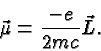
For the orbital angular momentum in a normal atom, the magnetic moment is
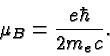
For the electron mass, in normal atoms, the magnitude of
 is one Bohr magneton,
If we choose the direction of
 to be the
 direction, then the
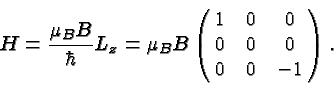
magnetic moment term in the Hamiltonian becomes
direction, then the
magnetic moment term in the Hamiltonian becomes
So the eigenstates of this magnetic interaction are the eigenstates of
 and
the energy eigenvalues are
and
the energy eigenvalues are
 , 0, and
 .
.
Example:
The energy eigenstates of an  system in a B-field.
Example:
Time development of a state in a B field.
Next: Spin
Up: Operators Matrices and Spin
Previous: Rotation operators for
James Branson
2001-09-17