next up previous
Next: Time Development of an Up: Examples Previous: A Rotated Stern-Gerlach Apparatus


Energy Eigenstates of an \bgroup\color{black}$\ell=1$\egroup System in a B-field

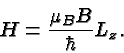
Recall that the Hamiltonian for a magnetic moment in an external B-field is

\begin{displaymath}\bgroup\color{black}H={\mu_B B\over\hbar} L_z.\egroup\end{displaymath}

As usual, we find the eigenstates (eigenvectors) and eigenvalues of a system by solving the time-independent Schroedinger equation \bgroup\color{black}$H\psi=E\psi$\egroup. We see that everything in the Hamiltonian above is a (scalar) constant except the operator \bgroup\color{black}$L_z$\egroup, so that

\begin{displaymath}\bgroup\color{black}H\psi={\mu_B B\over\hbar} L_z \psi= constant * (L_z \psi).\egroup\end{displaymath}

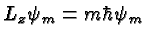
Now if \bgroup\color{black}$\psi_m$\egroup is an eigenstate of \bgroup\color{black}$L_z$\egroup, then \bgroup\color{black}$L_z\psi_m=m\hbar\psi_m$\egroup, thus

\begin{displaymath}\bgroup\color{black}H\psi_m={\mu_B B\over\hbar} * (m\hbar\psi_m)=(m\mu_B B)\psi_m\egroup\end{displaymath}

Hence the normalized eigenstates must be just those of the operator \bgroup\color{black}$L_z$\egroup itself, i.e., for the three values of \bgroup\color{black}$m$\egroup (eigenvalues of \bgroup\color{black}$L_z$\egroup), we have


\begin{displaymath}\bgroup\color{black}\psi_{m=+1}=\left(\matrix{1\cr 0\cr 0}\ri...
...ht)\qquad
\psi_{m=-1}=\left(\matrix{0\cr 0\cr 1}\right).\egroup\end{displaymath}

and the energy eigenvalues are just the values that \bgroup\color{black}$E=m\mu_B B$\egroup takes on for the three values of m i.e.,
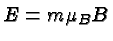


\begin{displaymath}\bgroup\color{black}E_{m=+1}=+\mu_B B\qquad
E_{m=0}=0\qquad
E_{m=-1}=-\mu_B B.\egroup\end{displaymath}


next up previous
Next: Time Development of an Up: Examples Previous: A Rotated Stern-Gerlach Apparatus
James Branson
2001-09-17