next up previous
Next: Expectation of in General Up: Examples Previous: Energy Eigenstates of an


Time Development of an \bgroup\color{black}$\ell=1$\egroup System in a B-field: Version I

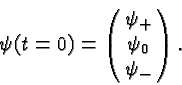
We will choose the z axis so that the B field is in the z direction. Then we know the energy eigenstates are the eigenstates of \bgroup\color{black}$L_z$\egroup and are the basis states for our vector representation of the wave function. Assume that we start with a general state which is known at \bgroup\color{black}$t=0$\egroup.

\begin{displaymath}\bgroup\color{black}\psi(t=0)=\pmatrix{\psi_+ \cr \psi_0\cr \psi_-}.\egroup\end{displaymath}

But we know how each of the energy eigenfunctions develops with time so its easy to write

\begin{displaymath}\bgroup\color{black}\psi(t)=\pmatrix{\psi_+e^{-iE_+t/\hbar} \...
...i\mu_BBt/\hbar} \cr \psi_0\cr \psi_-e^{i\mu_BBt/\hbar}}.\egroup\end{displaymath}

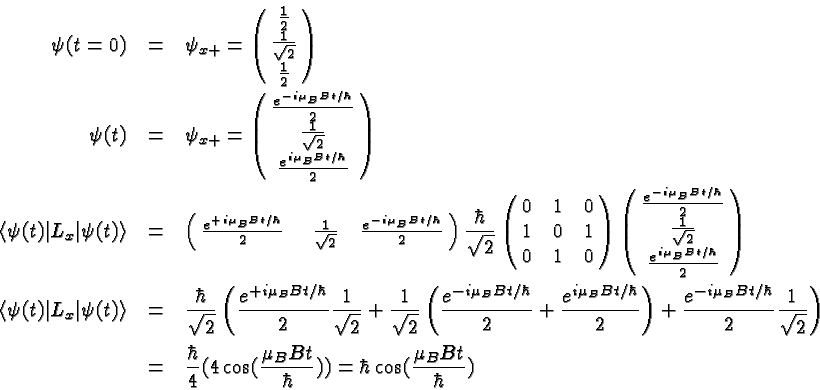
As a concrete example, let's assume we start out in the eigenstate of \bgroup\color{black}$L_x$\egroup with eigenvalue \bgroup\color{black}$+\hbar$\egroup.

\begin{eqnarray*}
\psi(t=0) & = & \psi_{x+}=\pmatrix{{1\over 2}\cr {1\over\sqrt...
...er 4}(4\cos({\mu_BBt\over\hbar}))=\hbar\cos({\mu_BBt\over\hbar})
\end{eqnarray*}


Note that this agrees with what we expect at \bgroup\color{black}$t=0$\egroup and is consistent with the angular momentum precessing about the z axis. If we checked \bgroup\color{black}$\langle\psi\vert L_y\vert\psi\rangle$\egroup, we would see a sine instead of a cosine, confirming the precession. Additional explanation


next up previous
Next: Expectation of in General Up: Examples Previous: Energy Eigenstates of an
James Branson
2001-09-17