


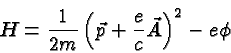

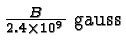
 compared to hydrogen binding energy),
and the second can be neglected.
The second term may be important in very high magnetic fields like those produced near
neutron stars or if distance scales are larger than in atoms (like in a plasma).
compared to hydrogen binding energy),
and the second can be neglected.
The second term may be important in very high magnetic fields like those produced near
neutron stars or if distance scales are larger than in atoms (like in a plasma).
So, for atoms, the dominant additional term is the one we anticipated classically
in section 1.5,
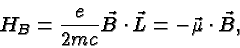
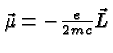 .
This is, effectively, the magnetic moment
due to the electron's orbital angular momentum.
In atoms, this term gives rise to the Zeeman effect: otherwise degenerate atomic states
split in energy when a magnetic field is applied.
Note that the electron spin which is not included here also contributes to the splitting and will
be studied later.
.
This is, effectively, the magnetic moment
due to the electron's orbital angular momentum.
In atoms, this term gives rise to the Zeeman effect: otherwise degenerate atomic states
split in energy when a magnetic field is applied.
Note that the electron spin which is not included here also contributes to the splitting and will
be studied later.
The Zeeman effect, neglecting electron spin, is particularly simple to calculate because the the
hydrogen energy eigenstates are also eigenstates of the additional term in the Hamiltonian.
Hence, the correction can be
calculated
exactly, (and easily).

 is the usual quantum number for the z component of orbital angular momentum.
The Zeeman splitting of Hydrogen states, with spin included,
was a powerful tool in understanding Quantum Physics
and we will discuss it in detail in 5.
is the usual quantum number for the z component of orbital angular momentum.
The Zeeman splitting of Hydrogen states, with spin included,
was a powerful tool in understanding Quantum Physics
and we will discuss it in detail in 5.