Next: Gauge Symmetry in Quantum
Up: Electrons in an Electromagnetic
Previous: The Quantum Hamiltonian Including
An important place where both magnetic terms come into play is in a plasma.
There, many electrons are not bound to atoms and external Electric fields are screened out.
Let's assume there is a constant (enough) B field in the z direction.
We then have cylindrical symmetry and will work in the coordinates,
 ,
,
 , and
, and
 .
.
Given the symmetry, we know that
 and
and
 commute with the Hamiltonian and will give
constants of the motion. We therefore will be able to separate variables in the usual way.
commute with the Hamiltonian and will give
constants of the motion. We therefore will be able to separate variables in the usual way.
In solving
the equation in
we may reuse the Hydrogen solution ultimately
get the energies
and associated LaGuerre polynomials (as in Hydrogen) in
 (instead of
 ).
The solution turns out to be simpler
using the Hamiltonian written in terms
of
).
The solution turns out to be simpler
using the Hamiltonian written in terms
of
 if we choose the right gauge by setting
 .
Then we actually can use our harmonic oscillator solution instead of hydrogen!
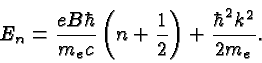
The energies come out to be
.
Then we actually can use our harmonic oscillator solution instead of hydrogen!
The energies come out to be
Neglecting the free particle behavior in
, these are called the Landau Levels.
This is an example of the equivalence of the two real problems we know how to solve.
Next: Gauge Symmetry in Quantum
Up: Electrons in an Electromagnetic
Previous: The Quantum Hamiltonian Including
James Branson
2001-09-17