Next: The Quantum Hamiltonian Including
Up: Electrons in an Electromagnetic
Previous: Electrons in an Electromagnetic
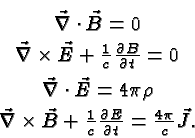
Maxwell's Equations in CGS units are
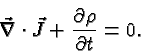
Conservation of charge gives us
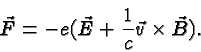
The Lorentz Force is
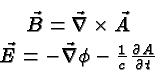
If we derive the fields from potentials,
then the first two Maxwell equations are automatically satisfied.
Applying the second two equations we get wave equations:
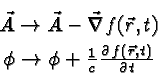
The Maxwell equations are invariant under a gauge transformation of the potentials.
Note that when we quantize the field, the potentials will play the role that wave functions
do for the electron, so this gauge symmetry will be important in quantum mechanics.
We can use the gauge symmetry to simplify our equations.
For time independent charge and current distributions,
the coulomb gauge,
 , is often used.
For time dependent conditions, the Lorentz gauge,
, is often used.
For time dependent conditions, the Lorentz gauge,
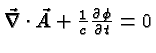 , is often convenient.
These greatly simplify the above wave equations in an obvious way.
, is often convenient.
These greatly simplify the above wave equations in an obvious way.
Finally, the classical Hamiltonian for electrons in an electromagnetic field becomes
The magnetic force is not a conservative one so we cannot just add a scalar potential.
We know that there is momentum contained in the field so the additional momentum term, as
well as the usual force due to an electric field, makes sense.
The electron generates an E-field and if there is a B-field present,
 gives rise to momentum density in the field.
The evidence that this is the correct classical Hamiltonian is that we can
derive
the Lorentz Force from it.
gives rise to momentum density in the field.
The evidence that this is the correct classical Hamiltonian is that we can
derive
the Lorentz Force from it.
Next: The Quantum Hamiltonian Including
Up: Electrons in an Electromagnetic
Previous: Electrons in an Electromagnetic
James Branson
2001-09-17