next up previous
Next: The Size of the Up: Derivations and Computations Previous: The Lorentz Force from


The Hamiltonian in terms of B

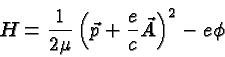
Start with the Hamiltonian

\begin{displaymath}\bgroup\color{black}H={1\over 2\mu}\left(\vec{p} + {e\over c}\vec{A}\right)^2 - e\phi\egroup\end{displaymath}

Now write the Schroedinger equation.

\begin{displaymath}\bgroup\color{black}{1\over{2\mu}}\left({\hbar\over i} \vec{\...
...er c}\vec{A}\psi \right)
= \left(E + e \phi\right)\psi \egroup\end{displaymath}

Multiply it out.

\begin{displaymath}\bgroup\color{black}{-\hbar^2\over{2\mu}}\nabla^2\psi - {ie\h...
...{e^2\over{2mc^2}}A^2\psi
= \left(E + e \phi\right)\psi \egroup\end{displaymath}


\begin{displaymath}\bgroup\color{black}{-\hbar^2\over{2\mu}}\nabla^2\psi
- {ie...
...{e^2\over{2mc^2}}A^2\psi
= \left(E + e \phi\right)\psi \egroup\end{displaymath}

The second term vanishes by the Coulomb gauge i.e., \bgroup\color{black}$\vec{\nabla}\cdot\vec{A}=0$\egroup, so

\begin{displaymath}\bgroup\color{black}{-\hbar^2\over{2\mu}}\nabla^2\psi - {ie\h...
...{e^2\over{2mc^2}}A^2\psi
= \left(E + e \phi\right)\psi \egroup\end{displaymath}

Now for constant \bgroup\color{black}$B_z$\egroup, we choose the vector potential

\begin{displaymath}\bgroup\color{black}\vec{A}=-{1\over 2}\vec{r}\times\vec{B}\egroup\end{displaymath}

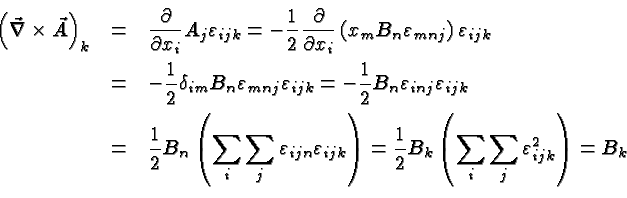
since

\begin{eqnarray*}
\left(\vec{\nabla}\times\vec{A}\right)_k
& = &{\partial\over{\...
...er 2}B_k \left(\sum_i \sum_j\varepsilon^2_{ijk}\right) = B_k \\
\end{eqnarray*}


it gives the right field and satisfies the Coulomb gauge condition.

Substituting back, we obtain

\begin{displaymath}\bgroup\color{black}{-\hbar^2\over{2\mu}}\nabla^2\psi
+ {ie\...
...imes\vec{B}\right)^2\psi
= \left(E + e \phi\right)\psi \egroup\end{displaymath}

Now let's work on the vector arithmetic.

\begin{displaymath}\bgroup\color{black}\left(\vec{r}\times\vec{B}\cdot\vec{\nabl...
...c{\nabla}\psi
= -{i\over\hbar}\vec{B}\cdot\vec{L}\psi \egroup\end{displaymath}


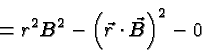
\begin{displaymath}\bgroup\color{black}\left(\vec{r}\times\vec{B}\right)^2
= r_...
...jr_iB_j - r_iB_jr_jB_i\right)\left(1-\delta_{ij}\right) \egroup\end{displaymath}


\begin{displaymath}\bgroup\color{black} = r^2 B^2 - \left(\vec{r}\cdot\vec{B}\right)^2 - 0 \egroup\end{displaymath}

So, plugging these two equations in, we get

\begin{displaymath}\bgroup\color{black}{-\hbar^2\over{2\mu}}\nabla^2\psi
+ {e\o...
...{B}\right)^2\right]\psi
= \left(E + e \phi\right)\psi. \egroup\end{displaymath}

We see that there are two new terms due to the magnetic field. The first one is the magnetic moment term we have already used and the second will be negligible in atoms.


next up previous
Next: The Size of the Up: Derivations and Computations Previous: The Lorentz Force from
James Branson
2001-09-17