


 states for the closed shells.
As we add valence electrons we follow Hund's rules to determine the ground state.
We get a great simplification by treating nearly closed shells as a closed shell plus
positively charged, spin
states for the closed shells.
As we add valence electrons we follow Hund's rules to determine the ground state.
We get a great simplification by treating nearly closed shells as a closed shell plus
positively charged, spin
 holes.
 (subject to the Pauli principle).
The Pauli principle rather than the rule, often determines everything here.
(subject to the Pauli principle).
The Pauli principle rather than the rule, often determines everything here. otherwise pick the lowest
  .
.This method of adding up all the spins and all the Ls, is called LS or Russel-Saunders coupling. This method and these rule are quite good until the electrons become relativistic in heavy atoms and spin-orbit effects become comparable to the electron repulsion. For very heavy atoms, we add the total angular momentum from each electron first then add up the Js. This is called j-j coupling.
A simpler way has been developed for chemists. It is based on the same principles. The only way to have a totally antisymmetric state is to have no two electrons in the same state. We use the same kind of trick we used to get a feel for addition of angular momentum; that is, we look at the maximum z component we can get consistent with the Pauli principle.
 and call that
  .
. , and call this , but
don't allow any two electrons to be in the same state (of and ).
, and call this , but
don't allow any two electrons to be in the same state (of and ). as before.
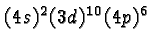
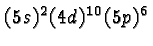
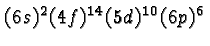
The following table gives the electron configurations for the ground states of light atoms.
| Z | El. | Electron Configuration |
 |
Ioniz. Pot. |
| 1 | H |
 |
 |
13.6 |
| 2 | He |
 |
 |
24.6 |
| 3 | Li | He(2s) |
|
5.4 |
| 4 | Be | He
 |
|
9.3 |
| 5 | B | He
 |
 |
8.3 |
| 6 | C | He
 |
 |
11.3 |
| 7 | N | He
 |
 |
14.5 |
| 8 | O | He
 |
 |
13.6 |
| 9 | F | He
 |
 |
17.4 |
| 10 | Ne | He
 |
|
21.6 |
| 11 | Na | Ne
 |
|
5.1 |
| 12 | Mg | Ne
 |
|
7.6 |
| 13 | Al | Ne
 |
|
6.0 |
| 14 | Si | Ne
 |
|
8.1 |
| 15 | Al | Ne
 |
|
11.0 |
| 16 | Si | Ne
 |
|
10.4 |
| 17 | P | Ne
 |
|
13.0 |
| 18 | S | Ne
 |
|
15.8 |
| 19 | K | Ar
 |
|
4.3 |
| 20 | Ca | Ar
 |
 |
6.1 |
| 21 | Sc | Ar
 |
 |
6.5 |
| 22 | Ti | Ar
 |
 |
6.8 |
| 23 | V | Ar
 |
 |
6.7 |
| 24 | Cr | Ar
 |
 |
6.7 |
| 25 | Mn | Ar
 |
 |
7.4 |
| 26 | Fe | Ar
 |
 |
7.9 |
| 36 | Kr | (Ar)
 |
 |
14.0 |
| 54 | Xe | (Kr)
 |
|
12.1 |
| 86 | Rn | (Xe)
 |
|
10.7 |
Example:
The Boron ground State.
Example:
The Carbon ground State.
Example:
The Nitrogen ground State.
Example:
The Oxygen ground State.