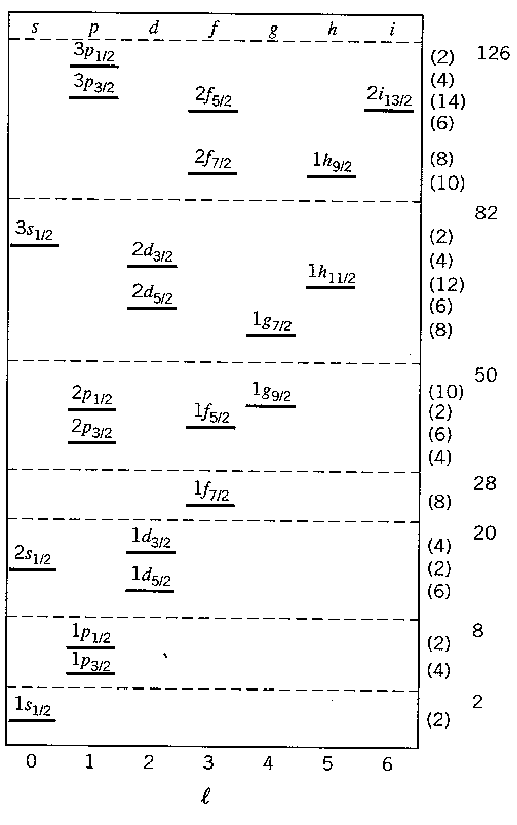
Even with the strong nuclear force, a shell model describes important features
of nuclei.
Nuclei have tightly bound closed shells for both protons and neutrons.
Tightly bound nuclei correspond to the most abundant elements.
What elements exist is governed by nuclear physics and we can get a good idea
from a simple shell model.
Nuclear magic numbers occur for neutron or proton number of
2, 8, 20, 28, 50, 82, and 126.
Nuclei where the number of protons or neutrons is magic are more tightly bound
and often more abundant.
Heavier nuclei tend to have more neutrons than protons because of the coulomb
repulsion of the protons (and the otherwise symmetric strong interactions).
Nuclei which are doubly magic are very tightly bound compared to neighboring
nuclei.
 is a good example of a doubly magic nucleus with many more protons than
neutrons.
is a good example of a doubly magic nucleus with many more protons than
neutrons.
Remember, its only hydrogen states which are labeled with a principle quantum number
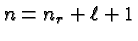 .
In the nuclear shell model,
.
In the nuclear shell model,
 refers only to the radial excitation so states like the
 show up in real nuclei and on the following chart.
The other feature of note in the nuclear shell model is that the nuclear spin orbit interaction is
strong and of the opposite sign to that in atoms.
The splitting between states of different
show up in real nuclei and on the following chart.
The other feature of note in the nuclear shell model is that the nuclear spin orbit interaction is
strong and of the opposite sign to that in atoms.
The splitting between states of different
 is smaller than but of the same order as splitting
between radial or angular excitations.
It is this effect and the shell model for which Maria Mayer got her Nobel prize.
is smaller than but of the same order as splitting
between radial or angular excitations.
It is this effect and the shell model for which Maria Mayer got her Nobel prize.