


 dimensional equation into
a 3 dimensional equation for each electron.
This equation depends on the wavefunctions of the other electrons but can be solved
in a self consistent way using the variational principle and iterating.
dimensional equation into
a 3 dimensional equation for each electron.
This equation depends on the wavefunctions of the other electrons but can be solved
in a self consistent way using the variational principle and iterating.


 represents the energy contribution of
electron
represents the energy contribution of
electron
 .
The term
.
The term
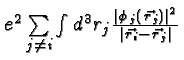 represents the potential due to the other electrons
in which electron
moves.
In this equation we can formally see the effect of screening by the other electrons.
The equation is derived (see Gasiorowicz pp 309-311) form the Schroedinger equation
using
represents the potential due to the other electrons
in which electron
moves.
In this equation we can formally see the effect of screening by the other electrons.
The equation is derived (see Gasiorowicz pp 309-311) form the Schroedinger equation
using
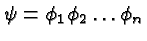 .
Since we will not apply these equations to solve problems, we will not go into the
derivation, however, it is useful to know how to proceed to solve more difficult problems.
.
Since we will not apply these equations to solve problems, we will not go into the
derivation, however, it is useful to know how to proceed to solve more difficult problems.
An improved formalism known as the Hartree-Fock equations, accounts for the required antisymmetry and gives slightly different results.