


 has the 1S and 2S levels filled giving
 as a base.
It has two valence 2P electrons.
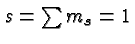
Hund's first rule , maximum total
as a base.
It has two valence 2P electrons.
Hund's first rule , maximum total
 , tells us to couple the two electron
spins to
, tells us to couple the two electron
spins to
 .
This is the symmetric spin state so we'll need to make the space state antisymmetric.
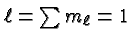
Hund's second rule, maximum
.
This is the symmetric spin state so we'll need to make the space state antisymmetric.
Hund's second rule, maximum
 , doesn't play a role because only the
 state is antisymmetric.
Remember, adding two P states together, we get total
state is antisymmetric.
Remember, adding two P states together, we get total
 .
The maximum state is symmetric, the next antisymmetric, and the
.
The maximum state is symmetric, the next antisymmetric, and the
 state is again symmetric under interchange.
This means
is the only option.
Since the shell is not half full we couple to the the lowest
state is again symmetric under interchange.
This means
is the only option.
Since the shell is not half full we couple to the the lowest
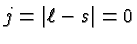 .
So the ground state is
.
So the ground state is
 .
The simpler way works with a table.
.
The simpler way works with a table.
 |
e |
| 1 |  |
| 0 | |
| -1 | |
 |
|
 |
|
We can take a look at the excited states of carbon to get an appreciation of
Hund's rules.
The following chart shows the states of a carbon atom.
For most states, a basis of
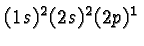 is assumed and the state of the
sixth electron is given.
Some states have other excited electrons and are indicated by a superscript.
Different
is assumed and the state of the
sixth electron is given.
Some states have other excited electrons and are indicated by a superscript.
Different
 states are not shown since the splitting is small.
Electric dipole transitions are shown changing
by one unit.
states are not shown since the splitting is small.
Electric dipole transitions are shown changing
by one unit.
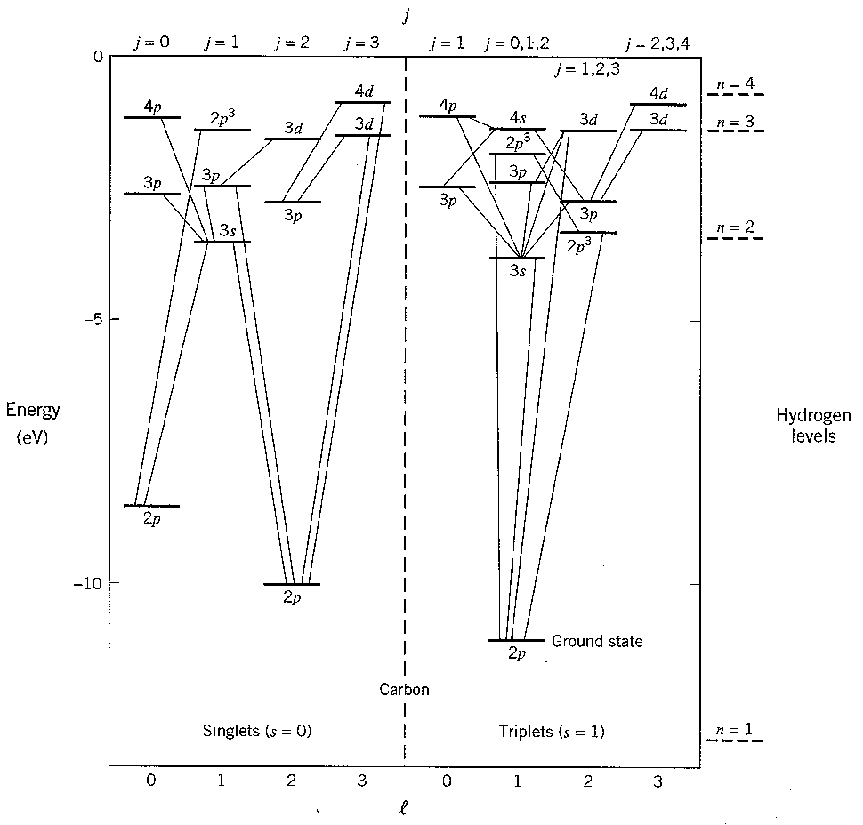
The ground state has
and
as we predicted.
Other states labeled
 are the ones that Hund's first two rules
determined to be of higher energy.
They are both spin singlets so its the symmetry of the space wavefunction
that is making the difference here.
are the ones that Hund's first two rules
determined to be of higher energy.
They are both spin singlets so its the symmetry of the space wavefunction
that is making the difference here.