


Next: The Angular Momentum Eigenfunctions Up: Angular Momentum Previous: Rotational Symmetry Contents
We have already derived the commutators of the angular momentum operators
![\begin{eqnarray*}[L_x,L_y]&=&i\hbar L_z \\
{[L_i,L_j]}&=&i\hbar\epsilon_{ijk}L_k \\
{[L^2,L_i]}&=&0 .\\
\end{eqnarray*}](img1690.png)
We have shown that angular momentum is quantized for a rotor with a single angular variable.
To progress toward the possible quantization of angular momentum variables in 3D,
we define the operator
 and its Hermitian conjugate
 .
.
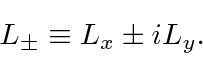
 commutes with
 and
and
 , it commutes with these operators.
![\begin{displaymath}\bgroup\color{black} [L^2,L_\pm]=0 \egroup\end{displaymath}](img1694.png)
The commutator with
 is.
is.
![\begin{displaymath}\bgroup\color{black} [L_\pm,L_z]=[L_x,L_z]\pm i[L_y,L_z]=i\hbar(-L_y\pm iL_x)=\mp\hbar L_\pm .\egroup\end{displaymath}](img1695.png)
From the commutators
![\bgroup\color{black}$[L^2,L_\pm]=0$\egroup](img1696.png) and
and
![\bgroup\color{black}$[L_\pm,L_z]=\mp\hbar L_\pm$\egroup](img1697.png) ,
we can
derive the effect of the operators
,
we can
derive the effect of the operators
 on the eigenstates
 ,
and in so doing, show that
,
and in so doing, show that
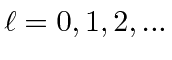
 is an integer greater than or equal to 0,
and that
is an integer greater than or equal to 0,
and that
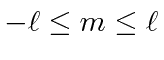
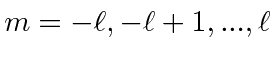
 is also an integer
|
|
|
 |
raises the
 component of angular momentum by one unit of
 and
lowers it by one unit.
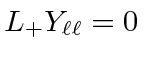
The raising stops when
and
lowers it by one unit.
The raising stops when
 and the operation gives zero,
 .
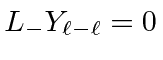
Similarly, the lowering stops because
.
Similarly, the lowering stops because
 .
.
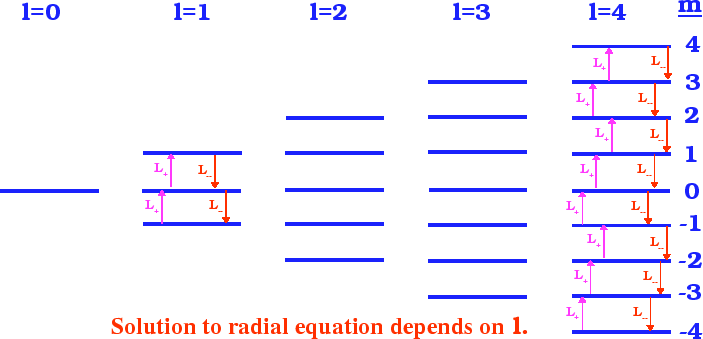
Angular momentum is quantized.
Any measurement of a component of angular momentum will give some integer times
.
Any measurement of the total angular momentum gives the somewhat curious result
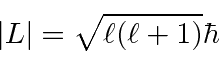 is an integer.
Note that we can easily write the components of angular momentum in terms of the raising and lowering operators.
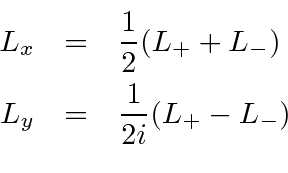
We will also find the following equations useful (and easy to compute).
![\begin{eqnarray*}[L_+,L_-]&=&i[L_y,L_x]-i[L_x,L_y]=\hbar(L_z+L_z)=2\hbar L_z \\
L^2&=&L_+L_-+L_z^2-\hbar L_z .\\
\end{eqnarray*}](img1710.png)
* Example:
What is the expectation value of  in the state
 ?*
?*
* Example:
What is the expectation value of  in the state
 ?*
?*