


Next: Examples Up: Derivations and Computations Previous: Spherical Coordinates and the Contents

The next step is to figure out how the
operators change the eigenstate
 .
What eigenstates of
.
What eigenstates of
 are generated when we operate with
 or
or
 ?
?
 commutes with
, we see that we have the same
commutes with
, we see that we have the same
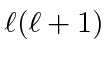 after operation.
This is also true for operations with
after operation.
This is also true for operations with
 .
.
 ,
and
,
and
 do not change
 .
That is, after we operate, the new state is still an eigenstate of
with the same eigenvalue,
.
.
That is, after we operate, the new state is still an eigenstate of
with the same eigenvalue,
.
The eigenvalue of
is changed when we operate with
or
.
![\begin{eqnarray*}
L_z(L_\pm Y_{\ell m})&=&L_\pm L_z Y_{\ell m}+[L_z,L_\pm]Y_{\e...
...pm\hbar L_\pm Y_{\ell m}
=(m\pm 1)\hbar (L_\pm Y_{\ell m}) \\
\end{eqnarray*}](img1778.png)
From the above equation we can see that
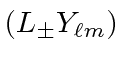 is an eigenstate of
.
is an eigenstate of
.

 component of angular momentum by one unit of
 .
.
Since
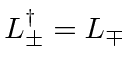 , its easy to show that the following is greater than zero.
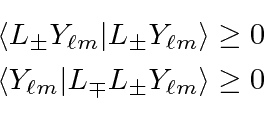
 in terms of our chosen operators,
![\begin{eqnarray*}
L_\mp L_\pm&=&(L_x\mp iL_y)(L_x\pm iL_y)=L_x^2+L_y^2\pm iL_xL...
..._x \\
&=&L_x^2+L_y^2\pm i[L_x,L_y]=L^2-L_z^2\mp\hbar L_z \\
\end{eqnarray*}](img1784.png)
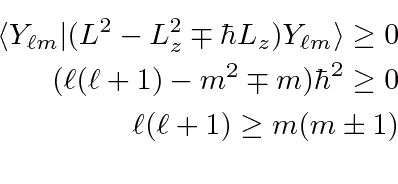
We know that the eigenvalue
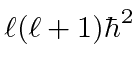 is greater than zero.
We can assume that
is greater than zero.
We can assume that
 .
.
The condition that
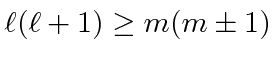 then becomes a limit on
 .
.
 raises
by one and
lowers
by one, and does not change
.
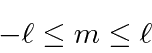
Since
is limited to be in the range
raises
by one and
lowers
by one, and does not change
.
Since
is limited to be in the range
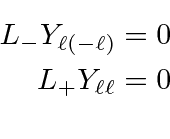
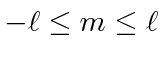 , the raising and lowering must stop
for
, the raising and lowering must stop
for
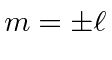 ,
,
 in integer steps, so, starting from
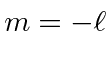 ,
there will be states in integer steps up to
.
,
there will be states in integer steps up to
.

 and the maximum at
 with integer steps only works if
 is an integer or a half-integer.
There are
is an integer or a half-integer.
There are
 states with the same
and different values of
.
We now know what eigenstates are allowed.
states with the same
and different values of
.
We now know what eigenstates are allowed.
The eigenstates of
and
should be normalized
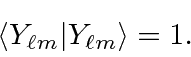 give
give
The coefficient
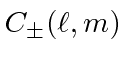 can be computed.
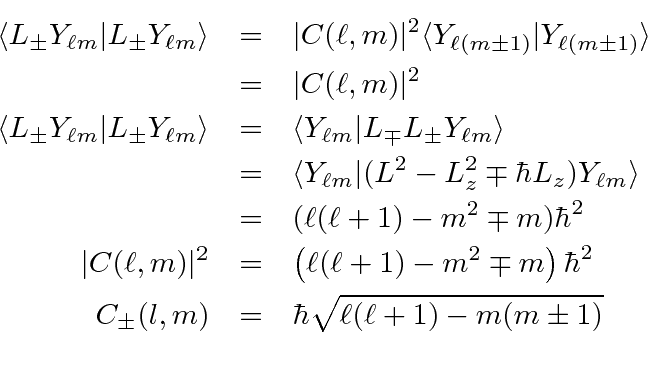
We now have the effect of the raising and lowering operators in terms of the normalized
eigenstates.

Jim Branson 2013-04-22