


 in the regular perturbation expansion.
That is, the zeroth order state will be allowed to be an arbitrary linear combination of the
degenerate states and the eigenvalue problem will be solved.
in the regular perturbation expansion.
That is, the zeroth order state will be allowed to be an arbitrary linear combination of the
degenerate states and the eigenvalue problem will be solved.
By looking at the zeroth and first order terms in the Schroedinger equation and dotting it into one of the
degenerate states
 , we
derive
the energy equation for first order (nearly) degenerate state perturbation theory
, we
derive
the energy equation for first order (nearly) degenerate state perturbation theory

where
 is the set of zeroth order states which are (nearly) degenerate with
 .
We recognize this as simply the (matrix) energy eigenvalue equation limited the list of
degenerate states.
We solve the equation to get the energy eigenvalues and energy eigenstates, correct to first order.
.
We recognize this as simply the (matrix) energy eigenvalue equation limited the list of
degenerate states.
We solve the equation to get the energy eigenvalues and energy eigenstates, correct to first order.
Written as a matrix, the equation is
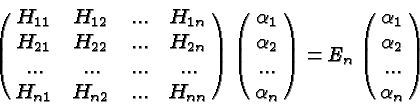
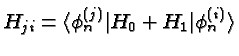 is the matrix element of the full Hamiltonian.
If there are n nearly degenerate states, there are n solutions to this equation.
is the matrix element of the full Hamiltonian.
If there are n nearly degenerate states, there are n solutions to this equation.
The Stark effect for the n=2 states of hydrogen requires the use of
degenerate state perturbation theory since there are four states
with (nearly) the same energies.
For our first calculation, we will ignore the hydrogen fine structure
and assume that the four states are exactly degenerate, each with unperturbed
energy of
 .
That is
.
That is
 .
The degenerate states
.
The degenerate states
 ,
,
 ,
,
 , and
, and
 .
.
Example:
The Stark Effect for n=2 States.
The perturbation due to an electric field in the z direction is
 .
The linear combinations that are found to diagonalize the full Hamiltonian in the
subspace of degenerate states are:
,
and
.
The linear combinations that are found to diagonalize the full Hamiltonian in the
subspace of degenerate states are:
,
and
 with energies of
 ,
, and
,
, and
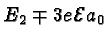 .
.