


 .
That is
.
That is
 .
The degenerate states
.
The degenerate states
 ,
,
 ,
,
 , and
, and
 .
.
The perturbation due to an electric field in the z direction is
 .
So our first order degenerate state perturbation theory equation is
.
So our first order degenerate state perturbation theory equation is

 and
can be eliminated from the equation.
and
can be eliminated from the equation.


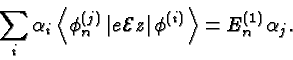
 which we can write out in (pseudo)matrix form
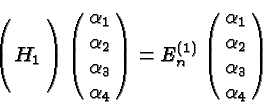 are zero.
We will show that because
are zero.
We will show that because
![\bgroup\color{black}$[L_z,z]=0$\egroup](img826.gif) , that all the matrix elements between states of unequal
, that all the matrix elements between states of unequal
 are zero.
Another way of saying this is that the operator z doesn't ``change''
.
Here is a little proof.
are zero.
Another way of saying this is that the operator z doesn't ``change''
.
Here is a little proof.
![\begin{displaymath}\bgroup\color{black}\left< Y_{lm}\left\vert[L_z,z]\right\vert...
...') \left<Y_{lm}\left\vert z \right\vert Y_{l'm'}\right> \egroup\end{displaymath}](img827.gif)
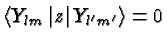 unless
 .
.
Lets define the one remaining nonzero (real) matrix element to be
 .
.
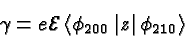
 ,
,
 , and
, and
 with eigenvalues (of
) of 0, 0, and
with eigenvalues (of
) of 0, 0, and
 .
.
What remains is to compute
.
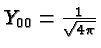
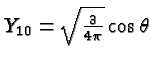
Recall
 and
and
 .
.



![\begin{displaymath}\bgroup\color{black} = {a_0 e {\cal E} \over{12}} \left[
\in...
...e^{-x}dx} - {1\over 2}\int^\infty_0 {x^5e^{-x}dx}\right]\egroup\end{displaymath}](img840.gif)
![\begin{displaymath}\bgroup\color{black} = {a_0 e {\cal E} \over{12}} \left[4\cdo...
... 1 \over 2} \right]
= {a_0 e {\cal E} \over{12}} (-36) \egroup\end{displaymath}](img841.gif)

If the states are not exactly degenerate, we have to leave in the diagonal terms of
.
Assume that the energies of the two (mixed) states are
 ,
where
,
where
 comes from some other perturbation, like the hydrogen fine structure.
(The
and
are still not mixed by the electric field.)
comes from some other perturbation, like the hydrogen fine structure.
(The
and
are still not mixed by the electric field.)


 , and
, and
 .
It is also correct when the two corrections are of the same order.
.
It is also correct when the two corrections are of the same order.