We can easily
derive
the matrices representing the angular momentum operators for  .
.

The matrices must satisfy the same commutation relations as the differential operators.
![\begin{displaymath}\bgroup\color{black}[L_x,L_y]=i\hbar L_z\egroup\end{displaymath}](img46.gif)
Since these matrices represent physical variables, we expect them to be Hermitian. That is, they are equal to their conjugate transpose. Note that they are also traceless.
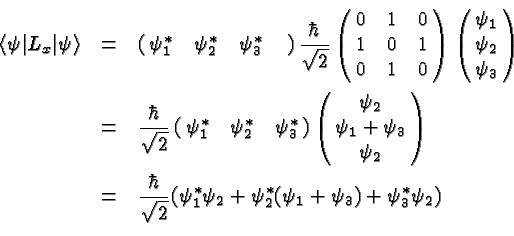
Let's compute an expectation value of
 in the matrix representation for the
general state
in the matrix representation for the
general state
 .
.