Next: The Angular Momentum Matrices
Up: Operators Matrices and Spin
Previous: Operators Matrices and Spin
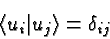
We will define our vectors as matrices using an orthonormal basis
 ,
like the eigenfunctions of a Hermitian operator.
These basis states are analogous to the orthonormal unit vectors in Euclidean space
,
like the eigenfunctions of a Hermitian operator.
These basis states are analogous to the orthonormal unit vectors in Euclidean space
 .
.
Define the components of a state vector
 (analogous to
 ).
).
The wavefunctions are therefore represented as vectors.
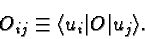
Define the matrix element
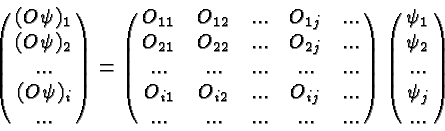
We know that an operator acting on a wavefunction gives a wavefunction.
If we dot
 into this equation from the left, we get
This is exactly the formula for a state vector equals a matrix operator times a state vector.
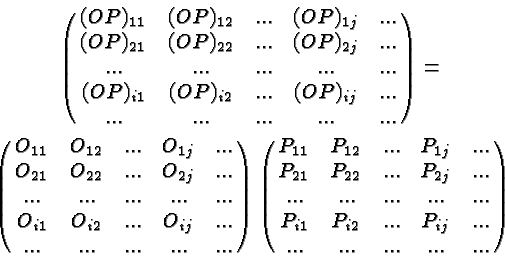
Similarly, we can look at the product of two operators
(using the identity
 ).
).
This is exactly the formula for the product of two matrices.
So, wave functions are represented by vectors and operators by matrices, all in the
space of orthonormal functions.
Example:
The Harmonic Oscillator Hamiltonian Matrix.
Example:
The harmonic oscillator raising operator.
Example:
The harmonic oscillator lowering operator.
Now compute the matrix for the Hermitian Conjugate of an operator.
The Hermitian Conjugate matrix is the (complex) conjugate transpose.
Check that this is true for  and
and  .
.
We know that there is a difference between a bra vector and a ket vector.
This becomes explicit in the matrix representation.
If
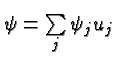 and
and
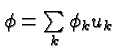 then, the dot product is
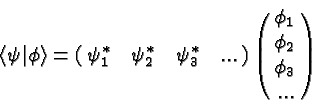
We can write this in dot product in matrix notation as
The bra vector is the conjugate transpose of the ket vector.
The both represent the same state but are different mathematical objects.
Next: The Angular Momentum Matrices
Up: Operators Matrices and Spin
Previous: Operators Matrices and Spin
James Branson
2001-09-17