


Next: Total Angular Momentum and Up: Addition of Angular Momentum Previous: Addition of Angular Momentum Contents
![\bgroup\color{black}$[p_{(1)i},x_{(2)j}]=0$\egroup](img2769.png) .
They are independent variables except that the overall wave functions for identical
particles must satisfy the (anti)symmetrization requirements.
This will also be the case for the spin coordinates.
.
They are independent variables except that the overall wave functions for identical
particles must satisfy the (anti)symmetrization requirements.
This will also be the case for the spin coordinates.
![\begin{displaymath}\bgroup\color{black}[S_{(1)i},S_{(2)j}]=0\egroup\end{displaymath}](img2770.png)
We define the total spin operators
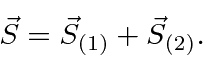
![\begin{displaymath}\bgroup\color{black}[S_{i},S_{j}]=i\hbar\epsilon_{ijk}S_k.\egroup\end{displaymath}](img2772.png)
This is a very important result since we derived everything about angular momentum from the commutators. The sum of angular momentum will be quantized in the same way as orbital angular momentum.
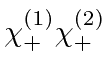
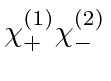
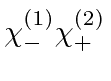
As with the combination of independent spatial coordinates, we can make product statesto describe the spins of two particles.
These products just mean, for example, the spin of particle 1 is up and the spin
of particle 2 is down.
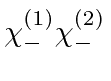
There are four possible (product) spin states when we combine two spin
 particles.
These product states are eigenstates of total
particles.
These product states are eigenstates of total  but not necessarily of total
 .
The states and their
.
The states and their
 eigenvalues are given below.
| Product State | Total
eigenvalue |
 |
 |
 |
 |
 |
|
 |
 |
Verify the quoted eigenvalues by calculation using the operator
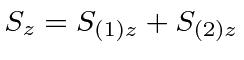 .
.
We expect to be able to form eigenstates of  from linear combinations of these
four states.
From pure counting of the number of states for each
eigenvalue, we can guess that
we can make one
from linear combinations of these
four states.
From pure counting of the number of states for each
eigenvalue, we can guess that
we can make one
 multiplet plus one
 multiplet.
The
multiplet has three component states, two of which are obvious from the list above.
We can use the lowering operator to derive
the other eigenstates of .
multiplet.
The
multiplet has three component states, two of which are obvious from the list above.
We can use the lowering operator to derive
the other eigenstates of .
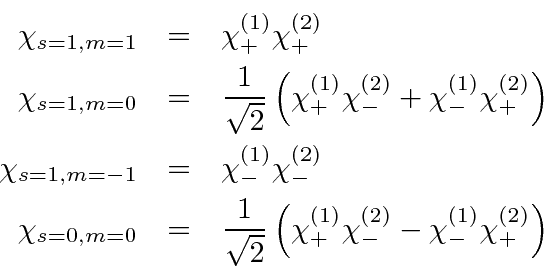
As a necessary check, we operate on these states with
and
verify
that they are indeed the correct eigenstates.
Note that by deciding to add the spins together, we could not change the nature
of the electrons.
They are still spin
and hence, these are all still eigenstates of
 and
and
 ,
however, (some of) the above states are not eigenstates of
,
however, (some of) the above states are not eigenstates of
 and
and
 .
This will prove to be a general feature of adding angular momenta.
Our states of definite total angular momentum and z component of total angular momentum
will still also be eigenstates of the individual angular momenta squared.
.
This will prove to be a general feature of adding angular momenta.
Our states of definite total angular momentum and z component of total angular momentum
will still also be eigenstates of the individual angular momenta squared.