


Next: Homework Problems 130A Up: Operators Matrices and Spin Previous: Homework Problems Contents
 is
is
 .
Use this to prove that if the
.
Use this to prove that if the  form an orthonormal complete set, then
the set
form an orthonormal complete set, then
the set
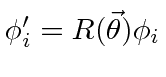 are also orthonormal and complete.
 is the
  one dimensional harmonic oscillator energy eigenstate:
a) Evaluate the matrix element
one dimensional harmonic oscillator energy eigenstate:
a) Evaluate the matrix element
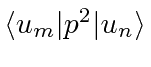 .
b) Write the upper left 5 by 5 part of the
.
b) Write the upper left 5 by 5 part of the  matrix.
 basis:
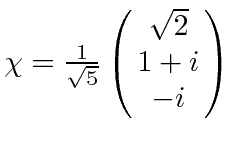 .
What is the probability that a measurement of the
.
What is the probability that a measurement of the  component of spin yields
zero?
What is the probability that a measurement of the
component of spin yields
zero?
What is the probability that a measurement of the  component of spin
yields
component of spin
yields  ?
?
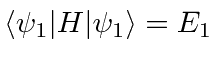 ,
,
 ,
,
 ,
,
 ,
and
,
and
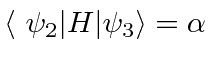 .
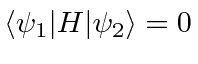
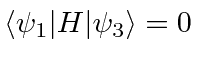
Assume all of the matrix elements are
real. What are the energy eigenvalues and eigenstates of the system?
At
.
Assume all of the matrix elements are
real. What are the energy eigenvalues and eigenstates of the system?
At  the system is in the state
  .
What is
.
What is  ?
?
 (matrix) operator for
  in the usual (
 ) basis.
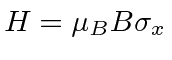
 particle is in a magnetic field in the direction
giving a Hamiltonian
particle is in a magnetic field in the direction
giving a Hamiltonian
 .
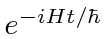
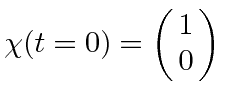
Find the time development (matrix) operator
.
Find the time development (matrix) operator
 in the usual basis.
If
in the usual basis.
If
 , find
  .
.
system is in the following state
in the usual basis:
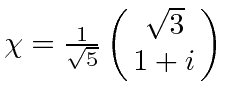 .
What is the probability that a measurement of the component of spin yields
.
What is the probability that a measurement of the component of spin yields
 ?
?
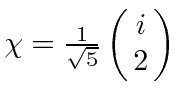
system is in the state
 (in the usual eigenstate basis).
What is the probability that a measurement of yields
(in the usual eigenstate basis).
What is the probability that a measurement of yields
 ?
What is the probability that a measurement of
?
What is the probability that a measurement of  yields
?
yields
?
object is in an eigenstate of
with eigenvalue  at t=0. The particle is in a magnetic
field
at t=0. The particle is in a magnetic
field  =
= 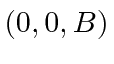 which makes the Hamiltonian for the system
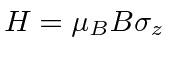 . Find the probability to measure
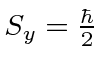 as a function of time.
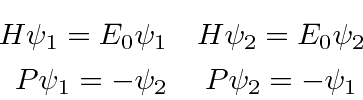
operator 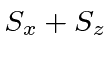 ?
?
object is in an eigenstate of
with eigenvalue at t=0. The particle is in a magnetic
field = which makes the Hamiltonian for the system
. Find the probability to measure
as a function of time.
 eigenstate basis):
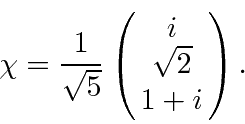
 yields 0?
What is the probability that a measurement of
yields 0?
What is the probability that a measurement of  yields
  ?
?
object is in an eigenstate of
with eigenvalue at t=0. The particle is in a magnetic
field = 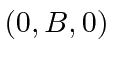 which makes the Hamiltonian for the system
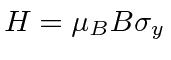 . Find the probability to measure
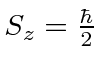 as a function of time.
 direction
such that the Hamiltonian is given by
direction
such that the Hamiltonian is given by
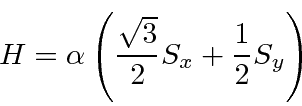
) electron is in an eigenstate of
with eigenvalue
 at . The particle is in a magnetic
field
at . The particle is in a magnetic
field  = which makes the Hamiltonian for the system
.
Find the spin state of the particle as a function of time.
Find the probability to measure
= which makes the Hamiltonian for the system
.
Find the spin state of the particle as a function of time.
Find the probability to measure
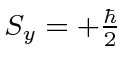 as a function of time.