


Next: Spherical Coordinates and the Up: Derivations and Computations Previous: The Commutators of the Contents
 Using
Using
 and
and
 operators to help us solve the central potential problem.
If we can rewrite
operators to help us solve the central potential problem.
If we can rewrite
 in terms of these operators, and remove all the angular derivatives,
problems will be greatly simplified.
We will work in Cartesian coordinates for a while, where we know the commutators.
in terms of these operators, and remove all the angular derivatives,
problems will be greatly simplified.
We will work in Cartesian coordinates for a while, where we know the commutators.
First, write out
.
![\begin{eqnarray*}
L^2&=&(\vec{r}\times\vec{p})^2 \\
&=&-\hbar^2\left[
\left...
...over\partial y}-y{\partial\over\partial x}\right)^2 \right] \\
\end{eqnarray*}](img1758.png)
![\begin{eqnarray*}
L^2=&-&\hbar^2\left[
x^2\left({\partial^2\over\partial z^2}...
...er\partial y}
+2z{\partial\over\partial z}\right) \right] \\
\end{eqnarray*}](img1759.png)
We expect to need to keep the radial derivatives
so lets identify those by dotting
 into
into
 .
This will also make the units match
.
.
This will also make the units match
.
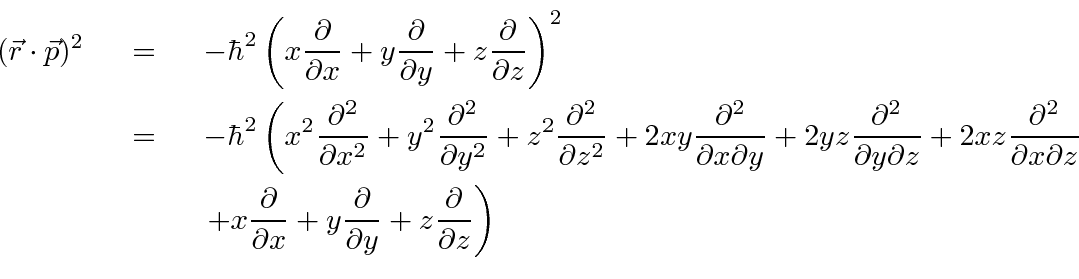
By adding these two expressions, things simplify a lot.

We can now solve for
 and we have something we can use in the Schrödinger equation.
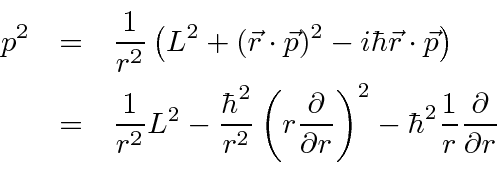
The Schrödinger equation now can be written with only radial derivatives and
.
![\begin{displaymath}\bgroup\color{black}{-\hbar^2\over 2\mu}\left[{1\over r^2}\le...
... r^2}\right] u_E(\vec{r})+V(r)u_E(\vec{r})=Eu_E(\vec{r})\egroup\end{displaymath}](img242.png)