


 plus spin
 .
.
 in terms of the
product states
in terms of the
product states
 .
We will do this by operating with the
.
We will do this by operating with the
 operator and setting the coefficients
so that we have eigenstates.
operator and setting the coefficients
so that we have eigenstates.
We choose to write the the quantum number
 as
as
 .
There are only two terms which have the right
.
If the spin is up we need
.
There are only two terms which have the right
.
If the spin is up we need
 and if the spin is down,
 .
.

We will find the coefficients
 and
and
 so that
 will be an eigenstate of

So operate on the right hand side with
.
![\begin{eqnarray*}
& J^2\psi_{j,m+{1\over 2}}
= \alpha\hbar^2 \left[ \ell(\ell +...
...qrt{\ell(\ell + 1) - (m+1)m} \sqrt{(1)} Y_{lm}\chi_+ \right] \\
\end{eqnarray*}](img678.gif)

 term gives

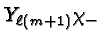 term gives
 terms on the LHS and
terms on the RHS, we get
terms on the LHS and
terms on the RHS, we get

![\begin{displaymath}\bgroup\color{black}\sqrt{(\ell-m)(\ell+m+1)}\alpha
= \left[j(j+1)-\ell(\ell + 1)-{3\over 4}+(m+1)\right]\beta .\egroup\end{displaymath}](img685.gif)
Now we just cross multiply so we have one equation with a common factor of
 .
.
![\begin{displaymath}\bgroup\color{black}(\ell-m)(\ell+m+1)=\left[j(j+1)-\ell(\ell...
...ght]
\left[j(j+1)-\ell(\ell+1)-{3\over 4}+(m+1)\right] \egroup\end{displaymath}](img687.gif)
 by
by
 .
.

These are now simple to solve

 .
We now need to go ahead and find
and
.
.
We now need to go ahead and find
and
.
Plugging
 into our first equation,
 and
.
We will normalize the wave function by setting
and
.
We will normalize the wave function by setting
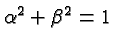 .
So lets get the squares.
.
So lets get the squares.


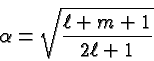

So we have completed the calculation of the coefficients. We will make use of these in the hydrogen atom, particularly for the anomalous Zeeman effect.
Writing this in the notation of matrix elements, we get
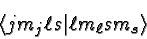




Similarly

