next up previous
Next: Homework Problems Up: Derivations and Computations Previous: A Hamiltonian Invariant Under


Magnetic Flux Quantization from Gauge Symmetry

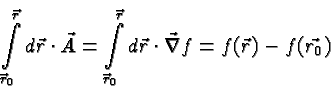
For simplicity, let's develop equations for regions with zero B field. We can choose a gauge transformation so that \bgroup\color{black}$\vec{A}'=0$\egroup and hence \bgroup\color{black}$\vec{A}=\vec{\nabla}f$\egroup. This will only be physically interesting for \bgroup\color{black}$\vec{B}$\egroup nonzero in other regions.

\begin{displaymath}\bgroup\color{black}\int\limits_{\vec{r}_0}^{\vec{r}}d\vec{r}...
...c{r}}d\vec{r}\cdot\vec{\nabla}f
=f(\vec{r})-f(\vec{r_0})\egroup\end{displaymath}

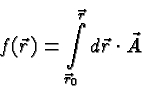
If we choose \bgroup\color{black}$f$\egroup so that \bgroup\color{black}$f(\vec{r_0})=0$\egroup, then we have

\begin{displaymath}\bgroup\color{black}f(\vec{r})=\int\limits_{\vec{r}_0}^{\vec{r}}d\vec{r}\cdot\vec{A}\egroup\end{displaymath}

\epsfig {file=fluxq.eps,height=2.5in}

Now consider two different paths from \bgroup\color{black}$\vec{r}_0$\egroup to \bgroup\color{black}$\vec{r}$\egroup.

\begin{displaymath}\bgroup\color{black}f_1(\vec{r})-f_2(\vec{r})=\oint d\vec{r}\...
...vec{\nabla}\times\vec{A}
=\int d\vec{S}\cdot\vec{B}=\Phi\egroup\end{displaymath}

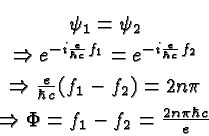
Now \bgroup\color{black}$f$\egroup is not a physical observable so the \bgroup\color{black}$f_1-f_2$\egroup does not have to be zero, but, \bgroup\color{black}$\psi$\egroup does have to be single valued.

\begin{eqnarray*}
& \psi_1=\psi_2 \\
& \Rightarrow e^{-i{e\over\hbar c}f_1}=e...
...f_2)=2n\pi \\
& \Rightarrow \Phi=f_1-f_2={2n\pi\hbar c\over e}
\end{eqnarray*}


Magnetic flux is observed to be quantized in a region enclosed by a superconductor. however, the fundamental charge seen is \bgroup\color{black}$2e$\egroup.


next up previous
Next: Homework Problems Up: Derivations and Computations Previous: A Hamiltonian Invariant Under
James Branson
2001-09-17