


Next: Sample Test Problems
Up: Time Dependent Perturbation Theory,
Previous: Derivations and Computations
- A hydrogen atom is placed in an electric field
which is uniform in space and turns on at
 then decays exponentially.
That is,
then decays exponentially.
That is,  for
for  and
and
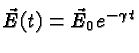 for
for  .
What is the probability that, as
.
What is the probability that, as
 , the
hydrogen atom has made a transition to the
, the
hydrogen atom has made a transition to the  state?
- A one dimensional harmonic oscillator is in its ground state.
It is subjected to the additional potential
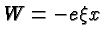 for a
a time interval
for a
a time interval  .
Calculate the probability to make a transition to the first
excited state (in first order).
Now calculate the probability to make a transition to the second
excited state. You will need to calculate to second order.
.
Calculate the probability to make a transition to the first
excited state (in first order).
Now calculate the probability to make a transition to the second
excited state. You will need to calculate to second order.
- Draw the energy level diagram for hydrogen up to
 .
Show the allowed E1 transitions.
Use another color to show the allowed E2 and M1 transitions.
.
Show the allowed E1 transitions.
Use another color to show the allowed E2 and M1 transitions.
- Calculate the decay rate for the
 transition.
- Photons from the
transition are observed coming from the sun.
Quantitatively compare the natural line width to the widths from
Doppler broadening and collision broadening expected for radiation
from the sun's surface.
Next: Sample Test Problems
Up: Time Dependent Perturbation Theory,
Previous: Derivations and Computations
James Branson
2001-09-17