


 Ion
ion.
It has two nuclei (A and B) sharing one electron (1).
Ion
ion.
It has two nuclei (A and B) sharing one electron (1).
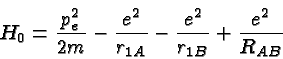
 is the distance between the two nuclei.
The lowest energy wavefunction can be thought of as a (anti)symmetric linear combination of an
electron in the ground state near nucleus A and the ground state near nucleus B.
![\begin{displaymath}\bgroup\color{black}\psi_\pm\left(\vec{r},\vec{R}\right)=C_\pm(R)\left[\psi_A\pm\psi_B\right]\egroup\end{displaymath}](img1373.gif)
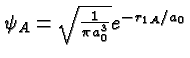 is g.s. around nucleus A.
 and
and
 are not orthogonal; there is overlap.
We must compute the normalization constant.
are not orthogonal; there is overlap.
We must compute the normalization constant.

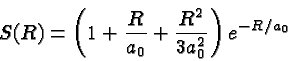
We can compute the energy of these states.
![\begin{eqnarray*}
\left<H_0\right>&=&{1\over {2[1\pm S(R)]}}\left<\psi_A\pm\psi_...
...> \pm \left<\psi_A\vert H_0\vert\psi_B\right> \over {1\pm S(R)}}
\end{eqnarray*}](img1379.gif)



![\begin{displaymath}\bgroup\color{black}\left<H_0\right>_{\pm}=E_1
{1-(2/y)(1+y)...
...y}-2(1+y)e^{-y}\right]
\over{ 1\pm (1+y+y^2/3)e^{-y}}} \egroup\end{displaymath}](img1383.gif)
The graph shows the energies expected from our calculation for the space symmetric and antisymmetric states as well as the result of a more complete calculation as a function of the distance between the protons.
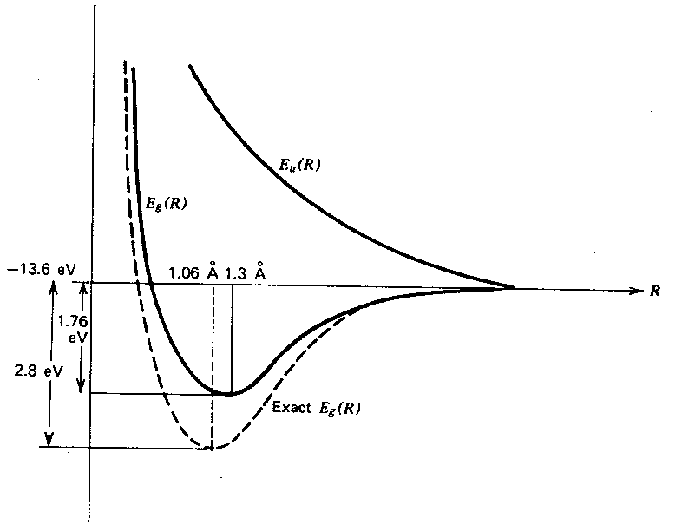
By setting
 , we can get the distance between atoms and the energy.
| Distance | Energy | |
| Calculated | 1.3 Å | -1.76 eV |
| Actual | 1.06 Å | -2.8 eV |
Its clear we would need to introduce some wfn. parameters to get good precision.