next up previous
Next: The Variational Principle (Rayleigh-Ritz Up: The Helium Atom Previous: The Helium Ground State

The First Excited State(s)

Now we will look at the energies of the excited states. The Pauli principle will cause big energy differences between the different spin states, even though we neglect all spin contribution in \bgroup\color{black}$H_1$\egroup This effect is called the exchange interaction.


\begin{displaymath}\bgroup\color{black}E^{(s,t)}_{1st} = {e^2\over 2}
\left< \p...
...100}\phi_{2\ell m} \pm \phi_{2\ell m} \phi_{100} \right>\egroup\end{displaymath}

The \bgroup\color{black}$s$\egroup for singlet corresponds to the plus sign.


\begin{displaymath}\bgroup\color{black} = {e^2\over 2} \left\{ 2\left< \phi_{100...
... \right\vert
\phi_{2\ell m}\phi_{100} \right> \right\} \egroup\end{displaymath}


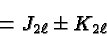
\begin{displaymath}\bgroup\color{black} = J_{2\ell}\pm K_{2\ell}\egroup\end{displaymath}

It's easy to show that \bgroup\color{black}$K_{2\ell}>0$\egroup. Therefore, the spin triplet energy is lower. We can write the energy in terms of the Pauli matrices:

\begin{displaymath}\bgroup\color{black}\vec{S}_1\cdot\vec{S}_2 ={1\over 2}(S^2-S...
...^2_2)
={1\over 2}\left[s(s+1)-{3\over 2}\right]\hbar^2 \egroup\end{displaymath}


\begin{displaymath}\bgroup\color{black}\vec{\sigma}_1\cdot\vec{\sigma}_2 = 4\vec...
...\matrix{1&\mbox{triplet}\cr -3&\mbox{singlet} }\right\} \egroup\end{displaymath}


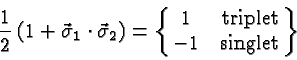
\begin{displaymath}\bgroup\color{black}{1\over 2}\left(1 + \vec{\sigma}_1\cdot\v...
...\matrix{1&\mbox{triplet}\cr -1&\mbox{singlet} }\right\} \egroup\end{displaymath}


\begin{displaymath}\bgroup\color{black}E^{(s,t)}_{1st} = J_{n\ell} - {1\over 2}\...
... 1 + \vec{\sigma}_1\cdot\vec{\sigma}_2\right) K_{n\ell} \egroup\end{displaymath}

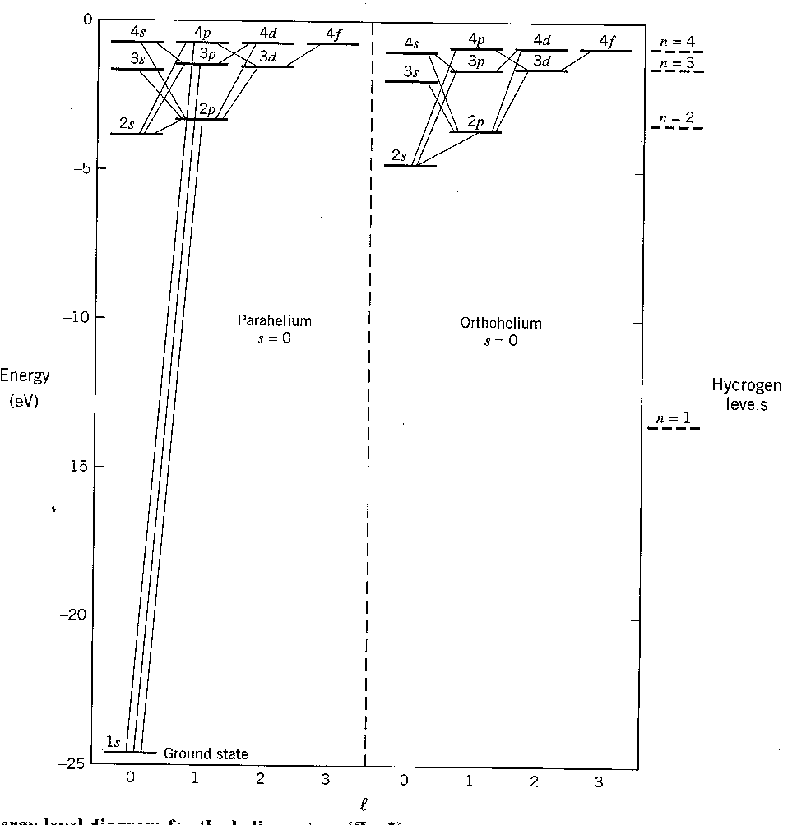
Thus we have a large effective spin-spin interaction entirely due to electron repulsion. There is a large difference in energy between the singlet and triplet states. This is due to the exchange antisymmetry and the effect of the spin state on the spatial state (as in ferromagnetism)
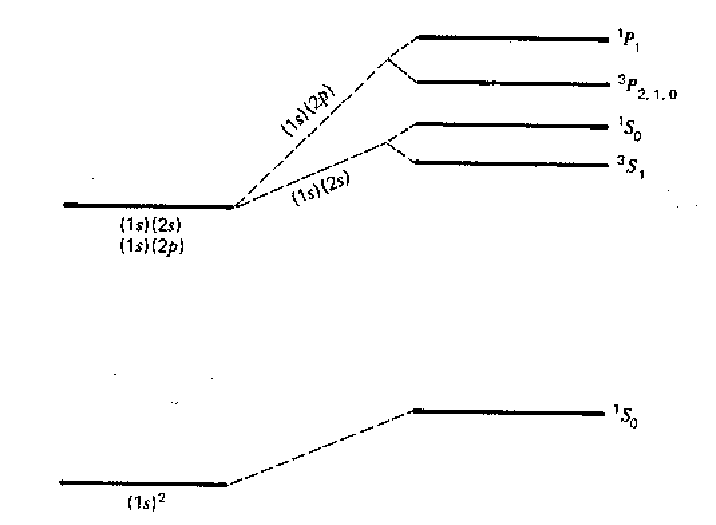
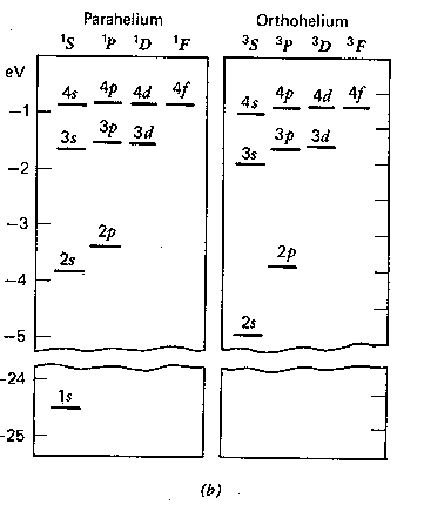
\epsfig {file=helium3.eps,height=3.5in} \epsfig {file=helium2.eps,height=3.5in} \epsfig {file=heliumjr.eps,height=5.5in}

In addition to the large energy shift, Electric Dipole decay selection rules

\begin{displaymath}\bgroup\color{black}\Delta\ell=\pm 1\egroup\end{displaymath}


\begin{displaymath}\bgroup\color{black}\Delta s=0\egroup\end{displaymath}

cause decays from triplet to singlet states (or vice-versa) to be suppressed by a large factor. This caused early researchers to think that there were two separate kinds of Helium.


next up previous
Next: The Variational Principle (Rayleigh-Ritz Up: The Helium Atom Previous: The Helium Ground State
James Branson
2001-09-17